ZoningSupply.com - Zone Control

HVAC Zone Controls & Zoning Dampers

hvac zoning system

What Happened in HVAC in 2025 — 20 Key Developments

HVAC Industryzoning supplyComment

1. The Refrigerant Phase-Out Takes Effect — R-410A Out, A2L Refrigerants In

On January 1, 2025, the U.S. regulatory environment shifted dramatically for HVAC systems. Under the framework of the Environmental Protection Agency (EPA) and the American Innovation and Manufacturing Act (AIM Act), manufacturing of HVAC equipment using high-Global Warming Potential (GWP) refrigerants — notably R-410A — was phased out. New systems now must use lower-GWP refrigerants such as R-454B or R-32. ACIQ+2Riteway AC+2
This shift aims to reduce the environmental footprint of HVAC systems, but it also introduced challenges: supply shortages for A2L-rated refrigerants, increased equipment prices due to added safety and compliance requirements, and a steep learning curve for contractors that must become certified in new refrigerant handling protocols. HVAC Informed+2ACHR News+2

Other key impacts: older systems using R-410A remain serviceable, but long-term maintenance is likely to grow more expensive, and new installs in 2025 and beyond will bear the burden of compliance. Superior CO-OP HVAC+1


2. The Rise of Heat Pumps and Electrified HVAC — “Electric is the Future”

One of the major themes of 2025 was accelerated adoption of heat pump technology. Heat pumps — especially advanced systems capable of operating efficiently even in cold climates — made big gains in both residential and commercial sectors. HVAC Informed+2Building Decarbonization Coalition+2

The drive toward electrification reflects broader decarbonization goals. For many building owners and facility managers, switching from fossil-fuel-based furnaces or boilers to all-electric heat pump solutions meant long-term energy savings, reduced carbon footprint, and compliance with emerging efficiency and environmental standards. Building Decarbonization Coalition+2Merlin Monitor+2

As climate policy and incentives from governments push toward cleaner energy, heat pumps are increasingly seen not as a niche alternative, but as the default for new HVAC installs or major retrofits. ACHR News+1


3. The 2025 AHR Expo: Industry’s Big Showcase for Change

In February 2025, the AHR Expo (held in Orlando) served as a major inflection point — showing where the HVACR market is headed. Attendance was strong (50,807 participants), and hundreds of exhibitors displayed the latest in equipment, controls, refrigerants, and smart automation. ACHR News+2Avnan+2

Key themes at the show included: transition to A2L refrigerants, proliferation of smart/IoT-enabled HVAC equipment, rising demand for high-efficiency systems, and increased emphasis on sustainability and decarbonization. ACHR News+2HVAC Informed+2

For many contractors and building owners, AHR Expo 2025 underscored that changes already underway — in regulation, product design, and market demand — are not temporary: they represent a new baseline for the entire industry. Avnan+1

4. Efficiency Standards Tighten — New DOE/EPA Rules on SEER, HSPF and More

In 2025, minimum efficiency requirements for HVAC equipment got more demanding. Compliance with upgraded standards for cooling (SEER/SEER2), heating (HSPF2), and overall fuel utilization (AFUE) became more widespread, pushing manufacturers to produce more efficient and greener systems. Northstar HVAC/R+2Mar-Hy Distributors+2

For building owners with older HVAC systems, this raised the cost-benefit bar for replacement vs. maintenance. For new installations, it meant choosing systems designed for long-term energy savings — and possibly qualifying for incentives or rebates tied to efficiency and environmental performance. Northstar HVAC/R+1

5. Smart & AI-Driven HVAC Control Gains Traction

2025 saw increased interest in integrating AI, IoT, and data-driven controls into HVAC systems. One recent academic study, for example, proposed a “Human-in-the-Loop” (HITL) framework that adapts HVAC operation based on real-time user feedback and changing electricity market prices — improving comfort while reducing energy costs. arXiv+1

Meanwhile, other studies focused on advanced ventilation and air-quality control: a data-driven operator learning model showed how machine-learning + ventilation controls can optimize airflow and maintain indoor air quality while minimizing energy use. arXiv

The result: HVAC is no longer “set it and forget it.” Smart, responsive controls are becoming a core part of system design — especially for larger or multi-zone buildings. HVAC Informed+1

6. Widespread Adoption of VRF & Hybrid VRF Systems in Commercial Settings

Variable Refrigerant Flow (VRF) systems — long favored in niche commercial projects — saw a surge in 2025 adoption. The shift is driven by their flexibility, efficiency, and suitability for buildings needing simultaneous heating and cooling, or varied climate zones (e.g., offices, hotels, schools). Merlin Monitor+2HVAC Informed+2

Hybrid VRF systems (some combining refrigerant with water-based distribution) also gained traction, particularly in retrofit projects replacing legacy chillers or boilers. These hybrid systems offer decarbonization potential while lowering operational expenses. HVAC Informed+1

As more building owners look to reduce emissions and energy costs, VRF — once a “premium” option — is becoming mainstream. ACHR News+1

7. Market Disruptions: Refrigerant Shortages, Pricing Challenges, Supply-Chain Strain

The transition to A2L refrigerants wasn’t smooth. Many contractors and distributors reported supply shortages, difficulty procuring sufficient refrigerant for new installs, and delays in project timelines. ACIQ+2HVAC Informed+2

The result: some homeowners and building managers postponed HVAC upgrades or chose to stick with older R-410A systems (while still possible), creating a temporary “two-speed” market. Others opted for alternative solutions — like heat pumps, VRF, or heat-pump water heaters — that avoid refrigerant supply constraints altogether. Harvest Thermal+2Merlin Monitor+2

8. Increased Demand for Training & Workforce — Technicians Need New Skills Fast

With the new refrigerants, heat-pump systems, VRF technology, and smart/AI-driven controls, the skill set required of HVAC professionals expanded rapidly in 2025. Contractors must now be certified in handling A2L refrigerants, familiar with modern heat-pump installation and maintenance procedures, and capable of commissioning smart control systems. HVAC Informed+2Mar-Hy Distributors+2

This has exacerbated an existing labor shortage in HVAC, but also opened opportunities for training, specialization, and higher-value services. For many smaller HVAC firms, the transition represents a strategic inflection point — adapt or risk being left behind. Mar-Hy Distributors+1

9. Air-to-Water Heat Pumps & Thermal Storage Gain Ground — Toward Electrified HVAC for Heating Season

This year brought broader adoption of air-to-water heat pump (AWHP) systems, especially in colder climates or where building plumbing is compatible. AWHPs offer a flexible, all-electric alternative to boilers, often with better efficiency and easier integration in retrofit and new-build projects. Harvest Thermal+1

In many cases, AWHPs were being specified alongside thermal storage solutions — for example, using heat-pump water heaters (HPWHs) controlled with predictive algorithms to store hot water or heat during low energy-cost periods. Early field studies showed promising energy savings using model-predictive control (MPC) for HPWHs. arXiv+1

For building owners and developers focused on decarbonization and resilience, AWHP + thermal storage began to look like a “future-proof” heating and hot-water solution in 2025.

10. Smart HVAC Controls & Zoning Surge — Targeted Comfort, Lower Energy Use

Multi-zone HVAC control got a real boost in 2025. With rising energy costs, upgraded refrigerant mandates, and more homes/buildings requiring flexible comfort control, zoning systems gained traction — especially those that are easy to install, compatible with existing equipment, and can integrate with smart thermostats. ZoningSupply.com - Zone Control+2Ecology Jay+2

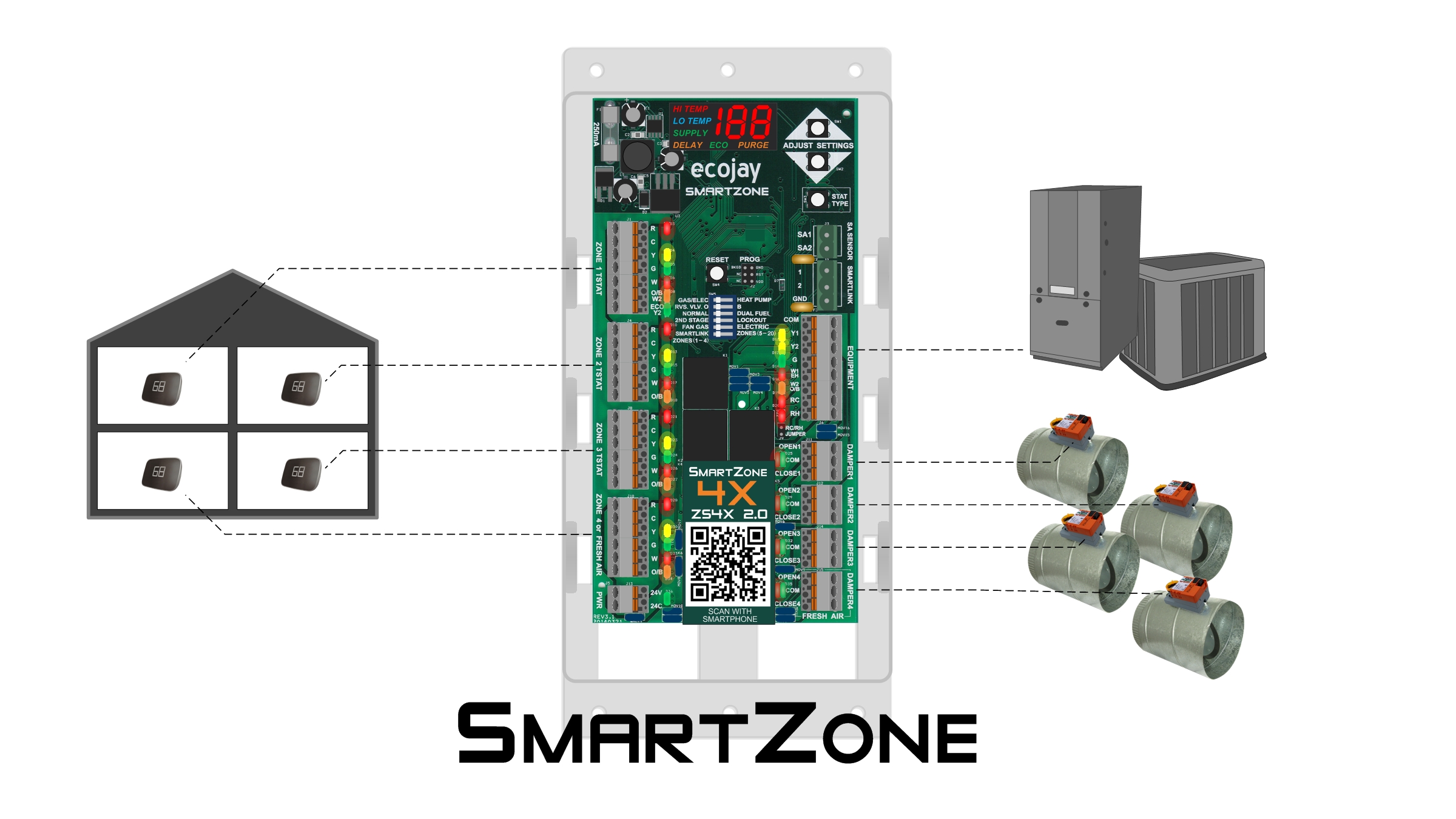
On that front, Ecojay’s release of SmartZone-4X 3.0 and SmartZone-3X 3.0 marked a notable milestone. The new 2025 controllers offer universal compatibility (gas, electric, heat pump, dual fuel, etc.), support for up to 20 zones (expandable), built-in fresh-air and economizer controls, de-humidification/de-humid modes, and configurable multi-stage control — all in a controller that installs far more simply than many legacy zone boards. Ecojay Products

The “3.0” update includes an improved bright color display, LED diagnostics on every terminal, fresh-air intake and humidity/economizer options — making zoning more accessible and practical for retrofits and new builds alike. EcoJay Products

For many homeowners and smaller commercial buildings that struggled with temperature imbalance, variable occupancy, or ductless HVAC discomfort — zoning with modern controllers became a go-to solution in 2025. As one distributor summary put it: for many applications, SmartZone 4X (or 3X) is the “clear winner” for universal compatibility, ease of install, and long-term reliability. ZoningSupply.com - Zone Control

11. Adoption of Smart Zoning & Dampers — Precision Airflow Control Comes of Age

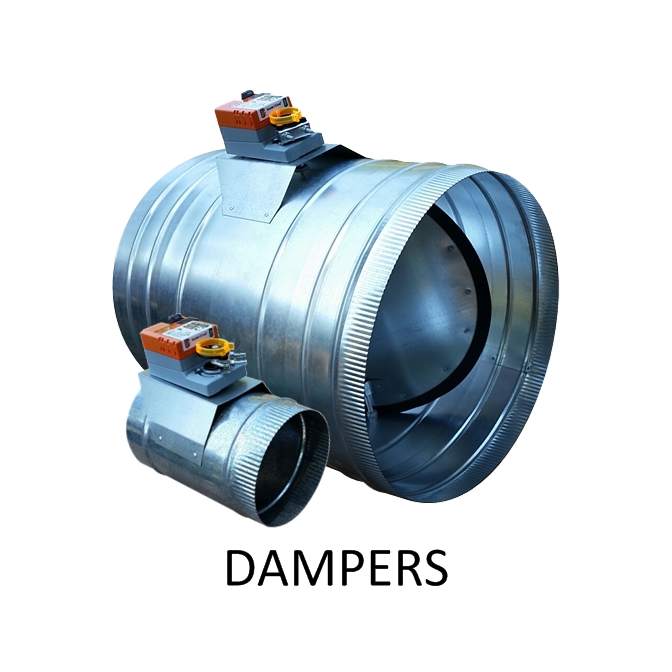
Beyond just zone controllers, 2025 also saw growing interest in integrating smart dampers and automated airflow controls in HVAC systems. This allows for even finer-grained control: each zone’s airflow can be adjusted not just by thermostats, but by damper status, supply-air sensors, and system logic responding to occupancy, air quality, or humidity. EcoJay SmartZone Spec

When combined with Ecojay’s SmartZone 3.0 / 4X 3.0 platforms, these systems can offer multi-zone control, fresh air ventilation, economy modes, staged heating/cooling, and dehumidification — all with a relatively simple, retrofit-friendly install.

This trend — toward airflow optimization rather than “one-size-fits-all” heating/cooling — reflects a broader shift in HVAC: from brute-force temperature control to intelligent, adaptive comfort systems.

12. Smart / AI-Powered Building HVAC Controls — From Theory to Real Deployments

Several research efforts published in 2025 pushed HVAC control past fixed schedules and static algorithms: machine-learning, occupancy detection, predictive control, and feedback-driven comfort management moved from labs into real-world simulation and field-test phases. arXiv+2arXiv+2

For example, one “Human-in-the-Loop” (HITL) model dynamically adapts HVAC operation based on user feedback and changing electricity prices, improving comfort while reducing energy consumption. arXiv

Another framework used neural-operator learning to optimize ventilation airflow and vent angles, offering substantial energy savings while maintaining indoor air quality. arXiv

As smart building technology becomes more common, these approaches could reshape how HVAC systems are designed, installed, and operated — especially in larger residential complexes, offices, or other multi-occupancy buildings.
13. Security & Privacy Research — HVAC Systems as Attack Surfaces

2025 wasn’t all about efficiency and comfort — researchers also flagged emerging risks tied to the increasing complexity and connectivity of HVAC systems. One academic paper introduced a framework for detecting cyber-physical attacks on HVAC components (sensors, actuators, networked controllers), using machine-learning to catch anomalies while preserving privacy. arXiv

Even more startling: another study demonstrated that common HVAC pressure sensors can be used to reconstruct intelligible human speech — meaning that HVAC systems might inadvertently become privacy or eavesdropping vulnerabilities. arXiv+1

These findings introduced a new set of concerns for building owners and managers: as HVAC becomes smarter and more connected, security and privacy need to become part of the spec.
14. Thermal Storage + Heat-Pump Water Heaters — A New Combo for Efficient Heating & Hot Water

Leveraging smart control and predictive algorithms, heat-pump water heaters (HPWH) paired with thermal storage — once thought of as a premium add-on — began to emerge as a viable, practical solution for many homes and multifamily buildings. A recent field study showed that a 120 V HPWH managed by a model-predictive control (MPC) system could pre-heat water ahead of demand, reduce energy costs by ~23–28%, and slash energy waste compared to traditional systems. arXiv

For developers and retrofit specialists, the appeal is clear: combined with A2L-compliant heat pumps or all-electric HVAC systems, thermal storage + HPWH offers low-carbon, efficient heating and hot-water — and reduced dependence on gas or fossil fuel systems going forward.

15. Retrofits & Upgrades Surge — Aging Systems, New Standards, and High Demand

Faced with new refrigerant regulations, rising energy costs, and pressure to decarbonize, many homeowners and building owners opted in 2025 to upgrade or retrofit older HVAC systems rather than continue band-aid repairs. This included replacing older R-410A systems, installing all-electric heat pumps, adding zoning boards and dampers, or integrating smart controls for better efficiency.

Contractors and distributors reported a spike in remodel and retrofit requests — especially from clients seeking to bring older systems into compliance or improve comfort in older homes and small commercial buildings. ACHR News+2HVAC Informed+2

These trends signal that 2025 — more than a regulatory transition year — may be a peak moment for modernizing America’s HVAC stock.

16. Renewable & Geothermal HVAC Solutions Gain More Attention

As decarbonization momentum grew, the industry saw renewed interest in geothermal heating/cooling, solar-assisted HVAC, and other renewable-energy–integrated solutions. Contractors and stakeholders began to position these technologies not just as “green” options, but as viable long-term alternatives, especially where clients wanted to minimize reliance on fossil fuels. PR Newswire+2Northstar HVAC/R+2

In some jurisdictions, this trend dovetailed with incentives and regulatory pressure — a combination likely to accelerate adoption in the next few years.

17. Awareness of Indoor Air Quality (IAQ) & Fresh-Air Ventilation — Zoning Controllers Adapt

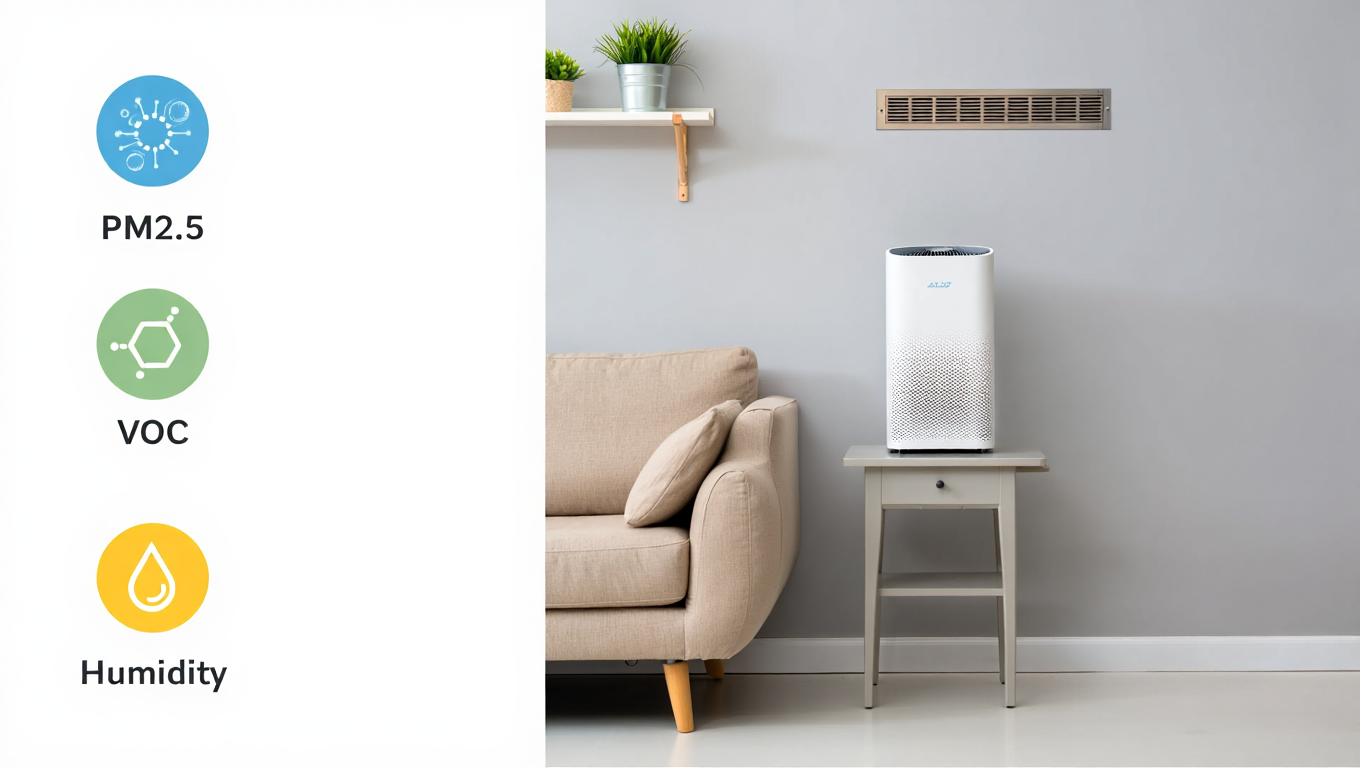
With increased focus on occupant health and building resilience post-pandemic, IAQ became more than just a “nice-to-have” topic. In 2025, many new HVAC products and controls emphasized built-in fresh-air intake, economizer modes, humidity control, and ventilation compliance with standards such as ASHRAE 62.2. EcoJay SmartZone SPEC

Zone control panels like Ecojay’s new SmartZone 3.0 / 4X 3.0 integrate fresh-air and economizer capabilities — making IAQ-focused ventilation part of the standard zoning package. Ecojay+2

For schools, multifamily residential, and commercial buildings, this shift underscored that HVAC isn’t just about comfort — it’s increasingly seen as a core element of occupant health, safety, and resilience.
18. Demand Surge & Backlogs — HVAC Supply Chain Under Pressure

Between refrigerant shortages, increased demand for heat pumps, and widespread retrofits, many HVAC contractors and distributors in 2025 found themselves with long lead times, backlogged installs, and stretched supply chains. Several reports pointed to delays in components, refrigerant cylinder shortages, and pressure on inventory of compliant equipment. ACIQ+2HVAC Informed+2

This environment drove up installation costs and wait times for homeowners — but also created opportunity for well-prepared contractors who secured materials early, invested in training, and offered bundled retrofit/zoning/upgrade services.

19. Growing Momentum for Building Electrification & Decarbonization — Regulatory & Market Forces Align

2025 felt like a turning point for building electrification. Regulatory pressure, incentives, public concern about emissions, and rising gas prices pushed more property owners to consider electrified HVAC, heat-pump water heaters, geothermal, solar-assist, and other low-carbon solutions. PR Newswire+2Merlin Monitor+2

As a result, HVAC design conversations began to shift. Rather than specifying “gas furnace plus A/C,” many architects, MEP engineers, and contractors started designing buildings from the ground up for electric heat — often with zoning, smart control, and renewable integration in mind.

20. Zoning & Damper-Based HVAC Control Comes Into Its Own — SmartZone 3.0 Leading the Way

One of the most notable developments in 2025 was the renewed focus on zoning and airflow control — especially for residential and light-commercial buildings. At the center of this movement was Ecojay’s release of SmartZone 3.0 (both 3-zone and 4-zone / multi-zone versions). Their new controllers — the SmartZone-3X 3.0 and SmartZone-4X 3.0 — combine universal compatibility (gas, electric, heat pump, etc.), support for up to 20 zones (expandable), built-in fresh-air and economizer controls, dehumidification modes, multi-stage staging controls, and a modern LED/status interface. EcoJay

For many homeowners, this meant zoning was no longer a niche luxury — it became an affordable, retrofit-friendly way to improve comfort, reduce energy waste, and manage airflow intelligently. According to distributors, SmartZone 4X 3.0 emerged as the “best overall” option for larger homes or light-commercial setups, while SmartZone 3X 3.0 offered strong value for mid-sized projects. ZoningSupply.com - Zone Control
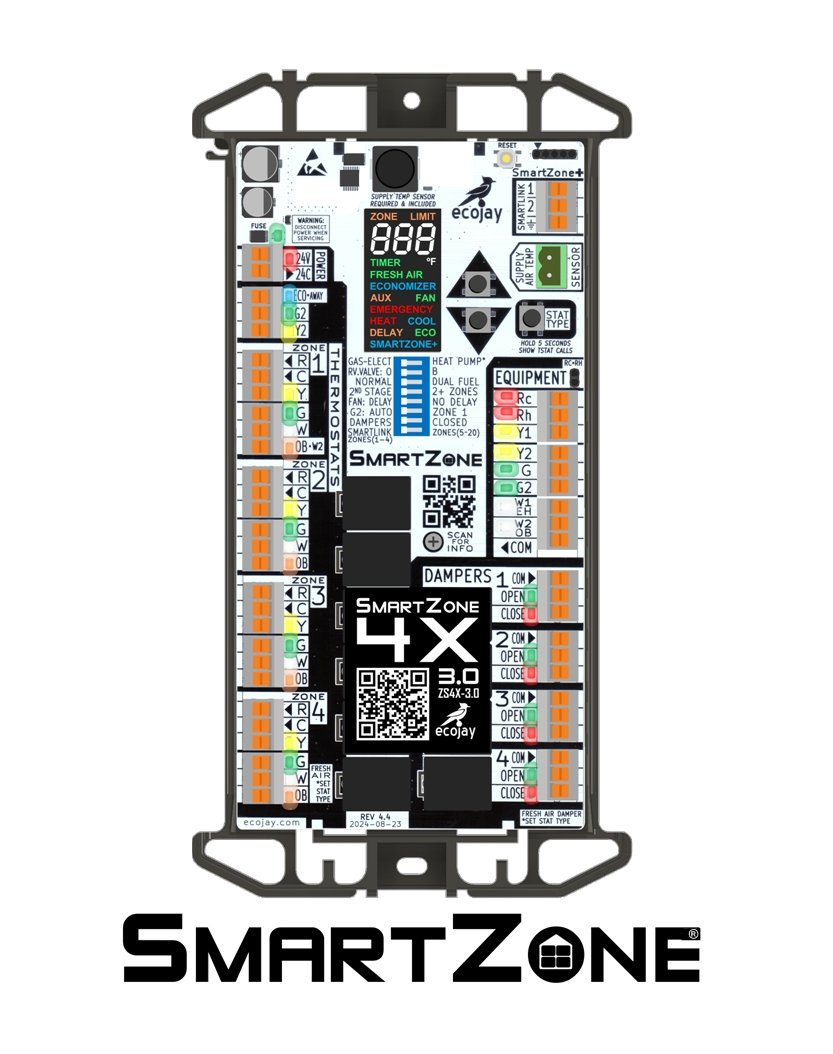
For contractors, the simplicity of installation — screwless terminals, dip-switch configuration, built-in supply-air sensor, and LED diagnostic feedback — helped reduce install time and complexity, making zoning a more attractive upsell or retrofit option. ecojay.com

Overall, 2025 may have marked the moment when zoning and damper-based control finally became “mainstream” in HVAC — not just for luxury homes, but for ordinary homes and small commercial buildings too.

Looking Back — What 2025 Means for the Future of HVAC

2025 was a watershed year. The combination of environmental regulation (phasing out high-GWP refrigerants), rising energy / carbon awareness, technological advances (heat pumps, smart controls, AI, zoning), and shifting market dynamics (retrofitting, supply strain, demand surge) forced the HVAC industry — contractors, manufacturers, building owners — to adapt quickly.

What stands out is that many of these changes point to a longer-term transformation: from HVAC as a commodity “cooling/heating box,” to HVAC as an integrated, efficient, adaptive, and even healthy system — delivering comfort, air quality, energy efficiency, and environmental responsibility.

The rise of smart zoning (e.g., Ecojay SmartZone 3.0), air-to-water heat pumps, thermal storage, AI-driven controls, and electrified systems suggest that “HVAC 2025” is really “HVAC 2035.”

If you’re a homeowner, building manager, or HVAC professional — 2025 was more than a transition year. It was the start of a new era.
What's a TON got to do with AC?

homeowners, Other HVACzoning supply2 Comments

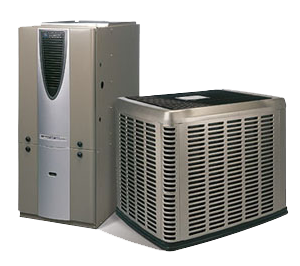
So you've probably heard of someone refer to an air conditioner's size in terms of  "TONS".  Something like "I got a new 4 TON HVAC unit".  This refers, not to physical size, but to the capacity (ability) of the equipment to generate heat.  That's right, even air conditioning (cooling), is sized by it's ability to produce heat.  In the case of air conditioning, the heat is being "pulled" from inside the house and dispersed outside.  This is why there is always an outdoor component (the air conditioning compressor) when you have AC.

Back to TONs... most people thing of a TON as being 2000 lbs. but with regard to HVAC, a TON is a measurement of heat generation per day.

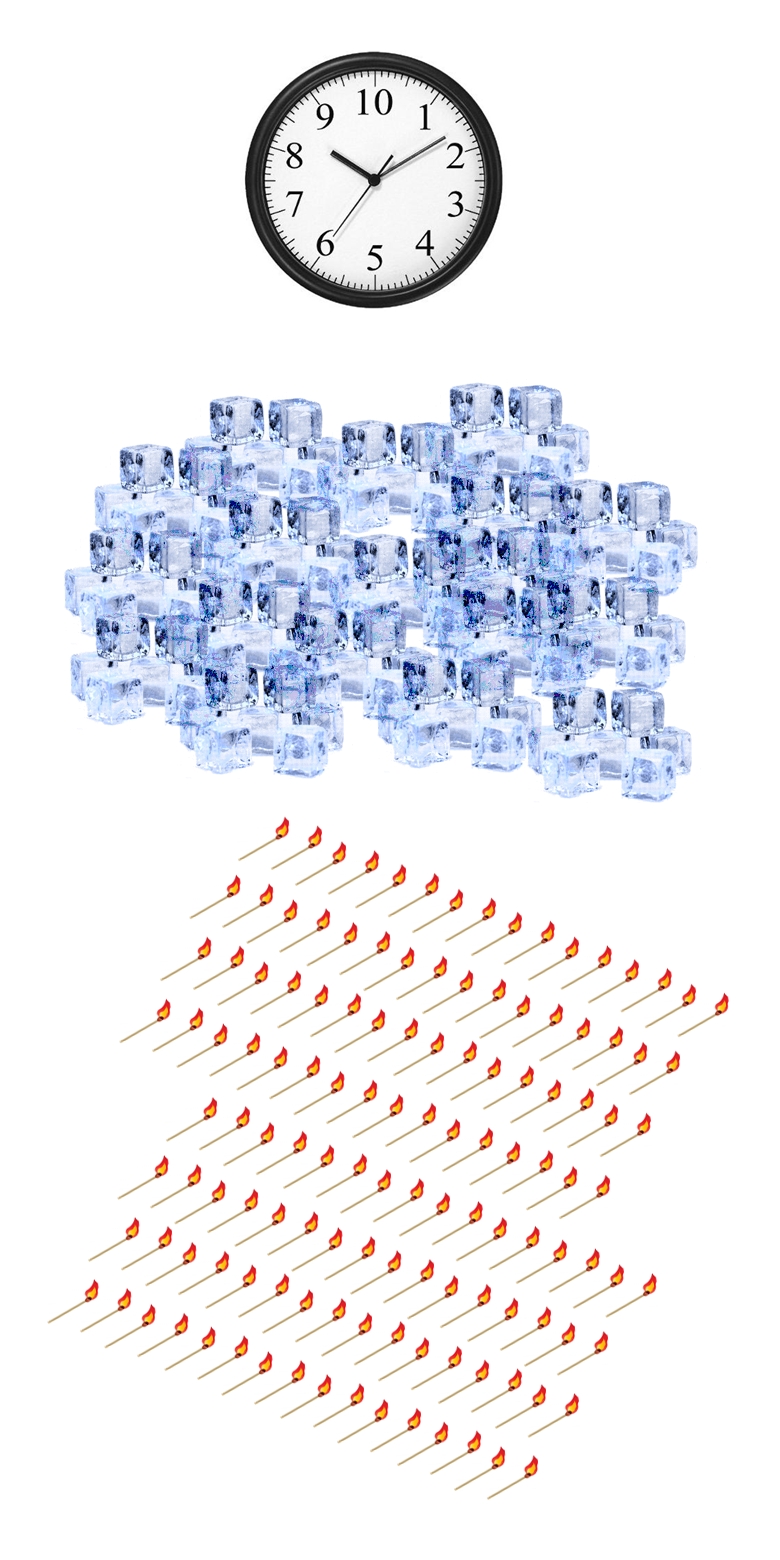
1 TON of air conditioning is a measure equivalent to the amount of heat necessary to melt 2000 lbs of ice (H20) in a 24 hour period.

ecojaytonexplain1.jpg

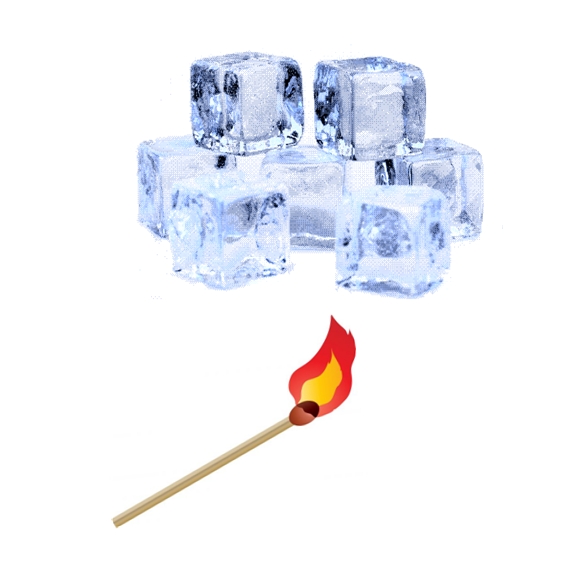
But how did we get there? A BTU (British Thermal Unit) is the unit we use express heat energy.  One BTU is equivalent to the amount of heat energy released when burning 1 match all the way. When rating an HVAC unit either for heating or cooling, the amount of BTUs per Hour is often sited.  It has been measured that it takes 143 BTUs to melt 1 lb of ice.  Since, 1 TON of ice is 2000lbs, It will take 2000 x 143 = 286,000 BTUs to melt 1 TON of ice.  The ice could be melted by lighting 286,000 matches all at once or by lighting one at a time... In other words, BTUs only tells us how much heat energy is necessary but not over what time period.  It could melt in 1 minute, 1 hour, or even 1 year depending on how the energy is generated.  So, to rate the output of HVAC equipment, someone decided back in the early 1900s (probably someone at Carrier) that it should be done over a 24 HR peroid (1 day).  This is how we get 286,000 BTUs / 24 hrs =~ 11,917 BTUs per hour or commonly know as 12K BTU/hr is equal to 1 TON.

ecojaytonexplain2.jpg

This means that that 4 TON AC unit you have can melt 8,000 lbs of ICE per day or about the same size block of ice as a Suburban.  That's a lot of heat energy!

De-humidification and SmartZone - Zone 1 Thermostat Control

HVAC Contractors, Other HVAC, Supportzoning supply1 Comment

Although SmartZone does not have any built-in capabilities for controlling DE-humidification (DH) or Humidification, some applications are possible by using a thermostat on ZONE 1 that does have the capability to control DH.

DE-humidification, in most residential systems, is simply running the equipment in COOLING with LOW speed fan instead of HI speed fan.

Before we get to zoning, the equipment being used must have the capability to control humidity.  This usually means it has a terminal (DH/BK/DS) that is energized or DE-energized by a thermostat to control fan speed of the equipment.  Controlling fan speed allows the equipment to DE-humidify the air when the fan is running in low speed.

Back to zoning, using zone 1 thermostat to control DH is not as simple as wiring directly from the thermostat to the equipment.  PLEASE DO NOT DO THIS.  The equipment and the zone thermostats are running on different transformers and this will case problems and potentially damage to some components.  You could isolate the output from the thermostat with a relay to get around this issue of different transformers but you would still have an issue with this method of wiring "around" the zone controller.  The issue can arise when zone 1 calls for DH but the equipment is already running in heat, this mixed signal might just be ignored by the equipment but we cannot take that for granted... all equipment works differently.

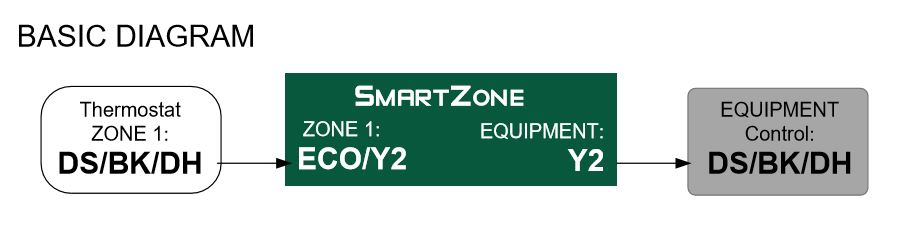
ecojay smartzone de-hum using y2 -BASIC.JPG

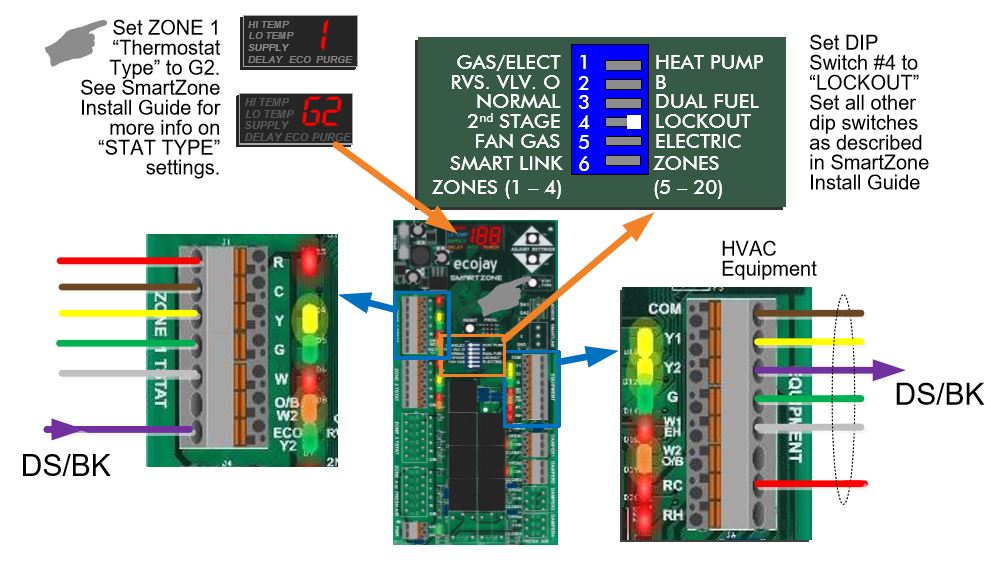
The best way to control DH using SmartZone on single stage equipment is by using the method below.  It may seem a little UN-orthidoxed but it is a valid APP note from the engineer at Ecojay (It's intended to work this way).

  1. Select a DH enabled thermostat of your choice
  2. Connect Y2/ECO on SmartZone Zone 1 to Zone 1 Thermostat DH/DS/BK
  3. Connect Y2 on SmartZone Equipment toEquipment DH/DS/BK
  4. Set Zone 1 "STAT TYPE" to G2
  5. Set DIP switch #4 to "LOCKOUT"

Zone 1 thermostat will now enable and disable DE-humidification any time the equipment is running in the cooling mode.
NOTE: When starting cooling from OFF state, 90 second delay will occur before HIGH speed fan will energize.

Using this method we are assuming that the equipment is expecting DS/BK/DH input terminal to be ENERGIZED for high speed fan and DE-ENERGIZED for low speed fan.  This method should not be used for more than 3 zones or with multi-stage compressor equipment.


SmartZone-2X
$199.00
 

This application will work with Ecojay's SmartZone-2X and SmartZone-4X.  Learn more

SmartZone 2X install guide
Click for SmartZone-2X/4X Install Guide

Click for SmartZone-2X/4X Install Guide

Need more than 40VA to power LOTs of dampers on one SmartZone?

HVAC Contractors, Supportzoning supplyComment

Some systems with many small ducts leading to each zone can require lots of dampers.  The example below is a 2 zone system that requires 6 dampers per zone (12 total).  If you look at the zoning guide, you will find that you should budget for at least 55VA for this system... but you only have 40 VA transformers.  75 and 100 VA transformers can get VERY expensive!  Instead you can use two 40VA transformers, but not how you think.  It can be dangerous and unreliable to connect transformers in parallel to create ~80VA.  We recommend the method below that employs the use of a simple relay to separate half of the dampers to be powered from a second transformer and the other half being powered by the SmartZone and it's transformer.

See the SmartZone Install Guide to calculate required VA.

It is always necessary to verify that the PRIMARY side power is sufficient to power the transformer connected.  A dedicated PRIMARY circuit is best but not always possible.  If sharing the 110V or 220V circuit, make sure the total power required for all devices connected (including zoning transformers) doesn't exceed the capacity of the circuit (usually 15 or 20 AMPS).

Where to get a relay?
Any 24V relay with a DPST or DPDT configuration will work.  The one pictured in the above diagram is available at ZoningSupply.com (see below).   If you are chosing your own relay, the "Contact" current rating will determine how many dampers can be connected.  (For example: A 10 Amp relay can handle up to 10 power open, power closed dampers)

24V Relay - DPDT
$14.99
 
Power Open/Close Motor
from $79.99

New & Improved Rectangle Dampers available at ZoningSupply.com

Products, HVAC Contractors, ZoningSupplyzoning supplyComment

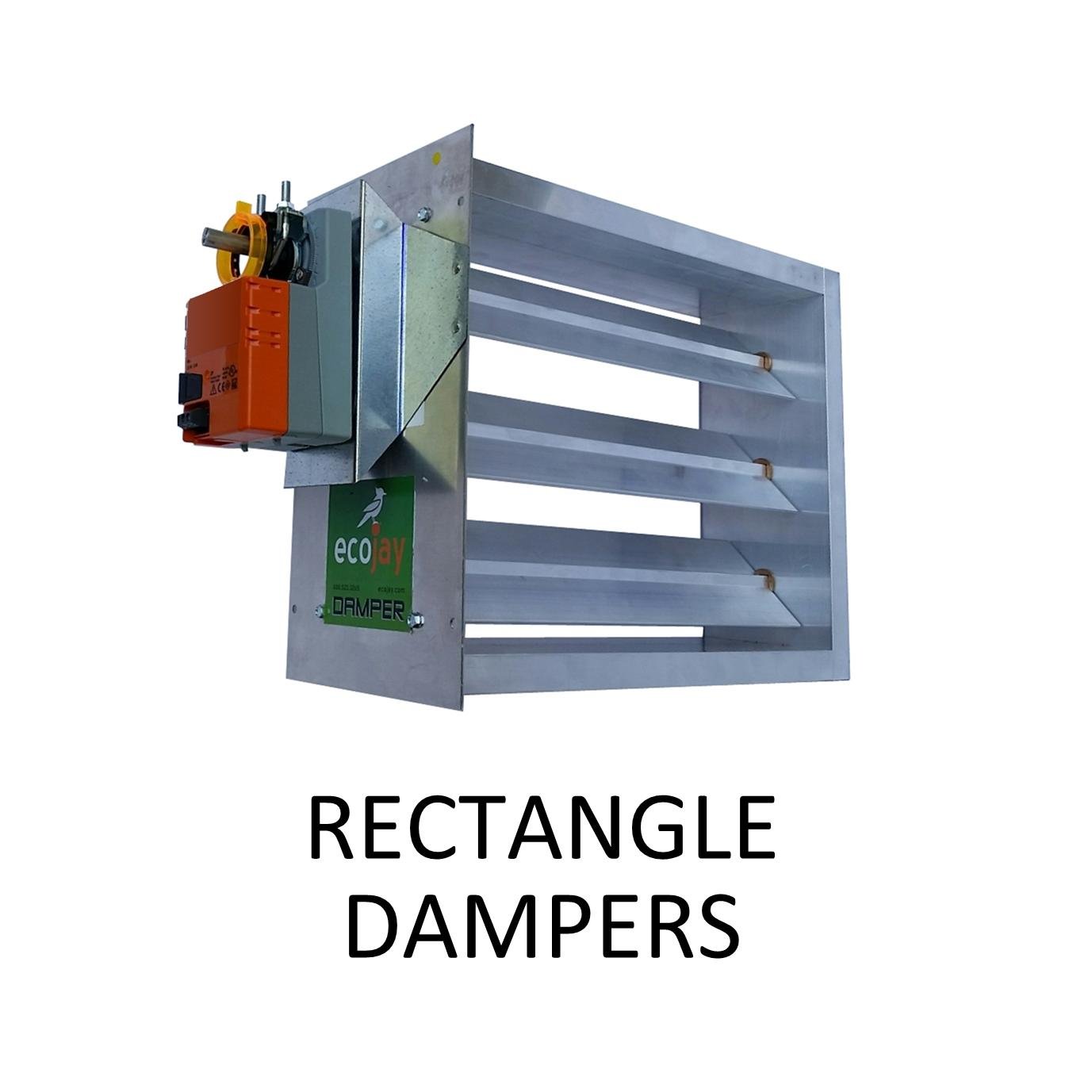
Tired of flimsy residential-grade rectangular dampers that easily bend and bind and, worse yet, stop working prematurely.  We, at ZoningSupply, are too!  And, we have the answer with this commercial-grade, super-duty rectangular damper.  Like all of our power dampers, it includes the best motor in the industry (Belimo) and now is constructed with heavy guage aluminim for rigidity and long-life.

Heavy-Duty

Rectangle Damper

Rectangular HVAC Dampers
from $199.99

6" X 6" thru 24" X 24"
SUPER Heavy-Duty
Aluminum rectangular damper w/ Ecojay by Belimo motor
Built to stand up to use and abuse

ATTENTION:

Due to delays receiving raw materials, the shipping time on these custom rectangular dampers has been extended: UP TO 3 or 4 WEEKS

We are very sorry about this delay and will be back to normal shipping times very soon! Please call us if you have any questions or concerns about your order.

DELIVERY TIME: UP TO 3 Weeks

(because they are custom made to order)
RETURNS for rectangular dampers require 20% restocking fee because they are custom made to order... please be sure you order the correct size.

NOTE: The motor will always be mounted on the “HEIGHT” side

No other rectangle zone damper on the market is as sturdy or reliable.  Simplicity of design and precision manufacturing in the USA (Ohio & Texas) make for the BEST rectangular damper that has ever been available to the residential zone control market.  Try it for yourself today.

More unbiased Zone control discusson on homeenergy

Other HVACzoning supplyComment

-------------------------------------------
QUESSTION by
Adam Zielinski

Homeowners with forced air duct systems always want to close the registers in rooms they aren't using, and close the doors to those rooms, in the belief that doing so will save energy and money.
I always thought doing this was over-rated and unlikely to save a significant amount of energy or money.  I could see doing it for one or two rooms perhaps, but sometimes homeowners close off half of their house or more.
This creates unbalanced air flow in the duct system and likely results in over heating the furnace heat exchanger, and or short cycling the furnace.  So the furnace spends a lot of time in start up mode and less time at peak efficiency.
I have not seen any real studies done on this however.  I'd like to see some data or research on this.

Reply by dale conner
Adam, most furnaces will move the proper amount of air through the blower and heat exchanger if the furnace cabinet pressure doesnt exceed .5 IWC and the furnace capacity was chosen based on a manual J calculation. This information can be found in the furnace installation manual or IOM (installation,operation,maintenance) that comes with a new furnace. However, this does not mean we are getting adequate air delivery to all of the rooms in the house due to excessive air leakage in the ducts and/or incorrect duct lengths or diameters routed to each room.

-----------------------------------------
QUESTION by Judi Lyall

How about using a motorized damper ?

Reply by dale conner
A single motorized damper can be used to control a zoned area but you also have to install a barometric by-pass damper to prevent over pressurization
www.zoningsupply.com

-----------------------------------------

See full discussion: http://homeenergypros.lbl.gov/group/hvac/forum/topic/show?id=6069565%3ATopic%3A7207

Honest discussion on homeenergypros about zoning advantages.

Other HVACzoning supplyComment

Are Zoned Heating/Cooling Systems a Good or Bad Idea?

Excerpt from homeenergypros discussion about HVAC Zone controls.

QUESTION by Jon LaMonte


For starters, I live in Atlanta, Ga and I am not an HVAC pro so this is a serious question that I would like answered for one of my clients.  I understand the premise of a zoned system and on the surface, it sounds like a good idea. Then I considered the fact that I have always told my customers that it is a bad idea to close off vents in rooms they are not in because of duct leakage.  Also, the second law of thermodynamics simply states the hot goes to cold, so now the unheated areas are doing their best to rob warm air from the heated areas.  Finally, if your zoning a single system, aren't you creating on oversizing issue because the unit (that was probably oversized in the first place) is now servicing a smaller area than what it was designed for?


Reply1 by Chris Heenan

Zoning has benefits beyond temp control. Most often the home does not require the full 2 stage heat or cooling as the system only needs to satisfy a portion of the home. So, then if 1/2 the heated air goes through a properly sized and balance bypass, the return air (from home) will mix with warm supply (from bypass) before going thru the system again. You may not need to go beyond 1stage heat (or cool) except in extremes. This is most beneficial in raising supply temps from heat pumps when in winter mode. Most supply vents feel 'cool' to homeowner. Not so when zoned and not call on all zones.

Flip it to cool, and the bypass send dehumidified cooler air across the coil. Decreasing high side pressures and amp draw of compressor. Then the air gets more heat extracted and further dehumidified. Pulling out additional condensate and running less. Remember systems have to be careful not to oversize as dehumidification is crucial to comfort. Dry and cool temps out supply vent. Not too shabby.


Reply2 by dale conner

Zone sytems are rarely installed properly but can be efficient if properly designed. The goal is to be able to set back the temperature a few degrees in a zone that isnt being utilized while keeping another zone comfortable that is being utilized.  A single unit with a zone system will have a by-pass duct sytem to dump the air thats been cut off from one zone back into the duct system to be used in the zone that is being used.


*Reply3 by James Jackson on

Have you ever been driving down the interstate hwy and come up on an exit ramp that has traffic backed up? As the traffic backs up and eventually fills the exit with cars you end up with a slight back up on the entire highway. this is the closest scenario i have been able to come up to help people understand why closing doors and vents is a bad idea. if you have a run off of a main trunk and you close the outlet or register you will cause the air to back up into the trunk causing turbulence in the trunk line resulting in a decrease in air flow in other areas on the system. this can also cause multiple other problems like pulsing and excessive noise from the increase in pressure.

another thing to remember when you shut doors in a home with no return air you cause a difference in pressure in the home. The room you have closed is now significantly positively pressurized and the house is now under a negative pressure. This why some homes have the doors undercut by 3-4 inches trying to allow the air to get back to the return.

Ok as far as the zone system goes... There is so much more thought involved in properly setting up a quality zone system that i see very few done correctly. If you want to do one correctly you first need to make sure you are using a multi-stage HVAC unit so the unit can run on low speed if it is only conditioning one zone. A bypass or crossover duct with a barometric damper is needed if you are conditioning a small zone and the air handler is still supplying too much air, but if you are going the zone route don’t use contractor grade units and piece it together with a simple zone controller. Get a high efficiency v speed unit that is designed for this application.

But what happens when you change the temps in a zone in the house 4-5 degrees?? Energy moves from hot to cold so you end up indirectly heating or cooling the entire space regardless. This brings us to another scenario. The return air in the zone that is off. My experience with working on correcting issues with homes using zone systems has been the returns are never dampered so if the zone is completely shut off you have just installed a permanent blower door. if the zone is off one you are returning hotter or colder air to the system and two you are causing that zone to have a negative pressure.

Just some things to think about !!


Learn more at www.zoningsupply.com

---------------------------------------------

BETTER with Zoning done right!

BETTER with Zoning done right!

Single thermostat can have issues

Single thermostat can have issues

My editorial conclusion:
Zoning CAN be effective if and ONLY if it's designed and installed properly.  This means ducts, dampers, equipment size (tons).  It also means the right zone panel setup with energy saving features like SmartZone.  Finally, to make zoning work best and comfort control and energy savings, the home owner must properly control the thermostats.  Zoning isn't a "set-it-and-forget-it" system, it must be managed to be effective.  More articles about zoning

See full discussion: http://homeenergypros.lbl.gov/group/hvac/forum/topic/show?id=6069565%3ATopic%3A7207

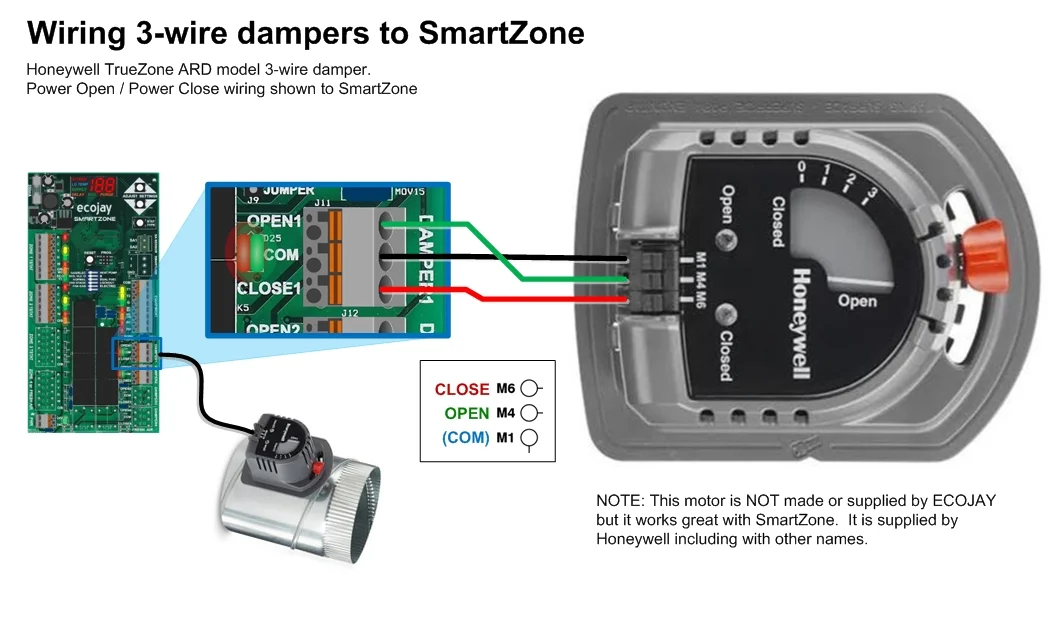
Honeywell TrueZone ARD Dampers wiring to SmartZone

Supportzoning supplyComment

The latest form Honeywell ARD dampers is a nice looking product and works nicely with ecojay SmartZone.  Wire as shown below.  Other damper wiring at www.zoningsupply.com/blog


SmartZone-4X
$299.00
PRO-Grade Power Zone Damper (Round)
from $69.99

SmartZone has the simplest setup and best features of any zone control. Find out more about SmartZone and why it's the smart choice: www.zoningsupply.com/buy-smartzone/

Best damper motor (actuator) on the market... we tested them all.

Productszoning supplyComment

Well, maybe not technically ALL of them but dozens and even more than in this photo.

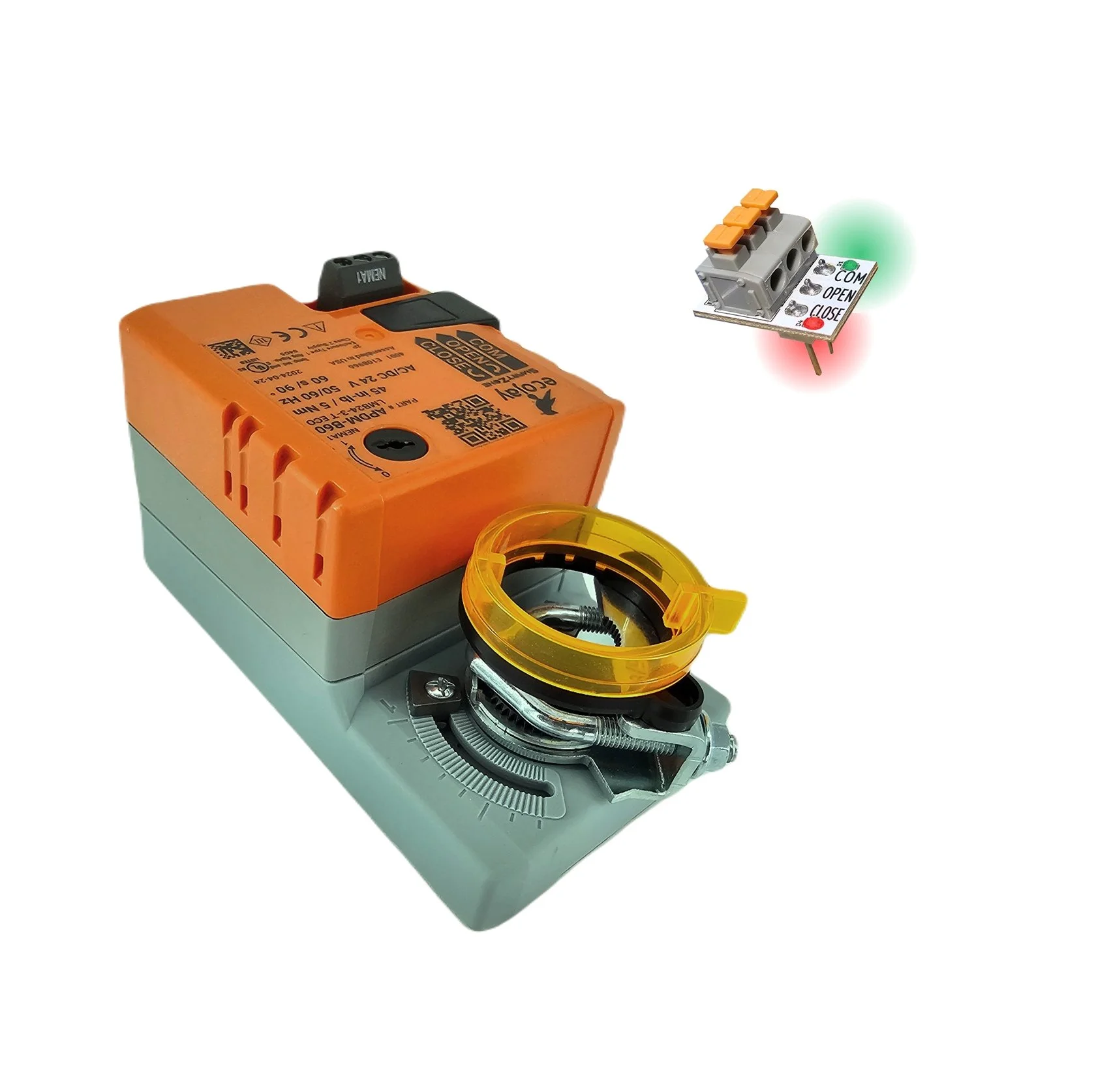
We narrowed down by specs that would work for us first.  Between 30 and 60 second travel time, 90 deg rotation, at least 1.5nM torque, lower than 3.5VA power consumption, 24Vac operation, clutch free movement, minimum open/close, range of 3/8" to 1/2" shaft and more.  Once we narrowed down to here we still had about 6 or 8 motors and we tested the top 5 for full 10 year accelerated life and field testing.  Some we even used in production for a while.  We are now confident when we proclaim that the Belimo motor that is made for ecojay and we sell with SmartZone wins in all categories... reliability, noise & installation/setup.

ecojay smartzone hvac zone damper actuator motor
PRO-Grade Power Zone Damper (Round)
from $69.99
Power Open/Close Motor
from $79.99

Damper Wiring: Yet another 5-terminal damper style wired to SmartZone

Supportzoning supply1 Comment

We confirmed today, thanks to a helpful customer, how another DuroZone damper wires using 3 wires (even though it has 5 terminals).

If your damper motors look like the one shown, wire to SmartZone as shown.

Another DuroZone model… on this model it is reported that some versions TERMINAL 4 (the blue wire shown) goes to CLOSE instead of OPEN.

If your motors looks different than this, see our other posts about damper wiring:
4-Terminal and 8-Terminal Damper Wiring

If the motors you have are not compatible with SmartZone, you still don't have to replace the whole damper.  You can replace just the motor (actuator) on just about any standard residential damper with the SmartZone / Belimo motor.

Power Open/Close Motor
from $79.99

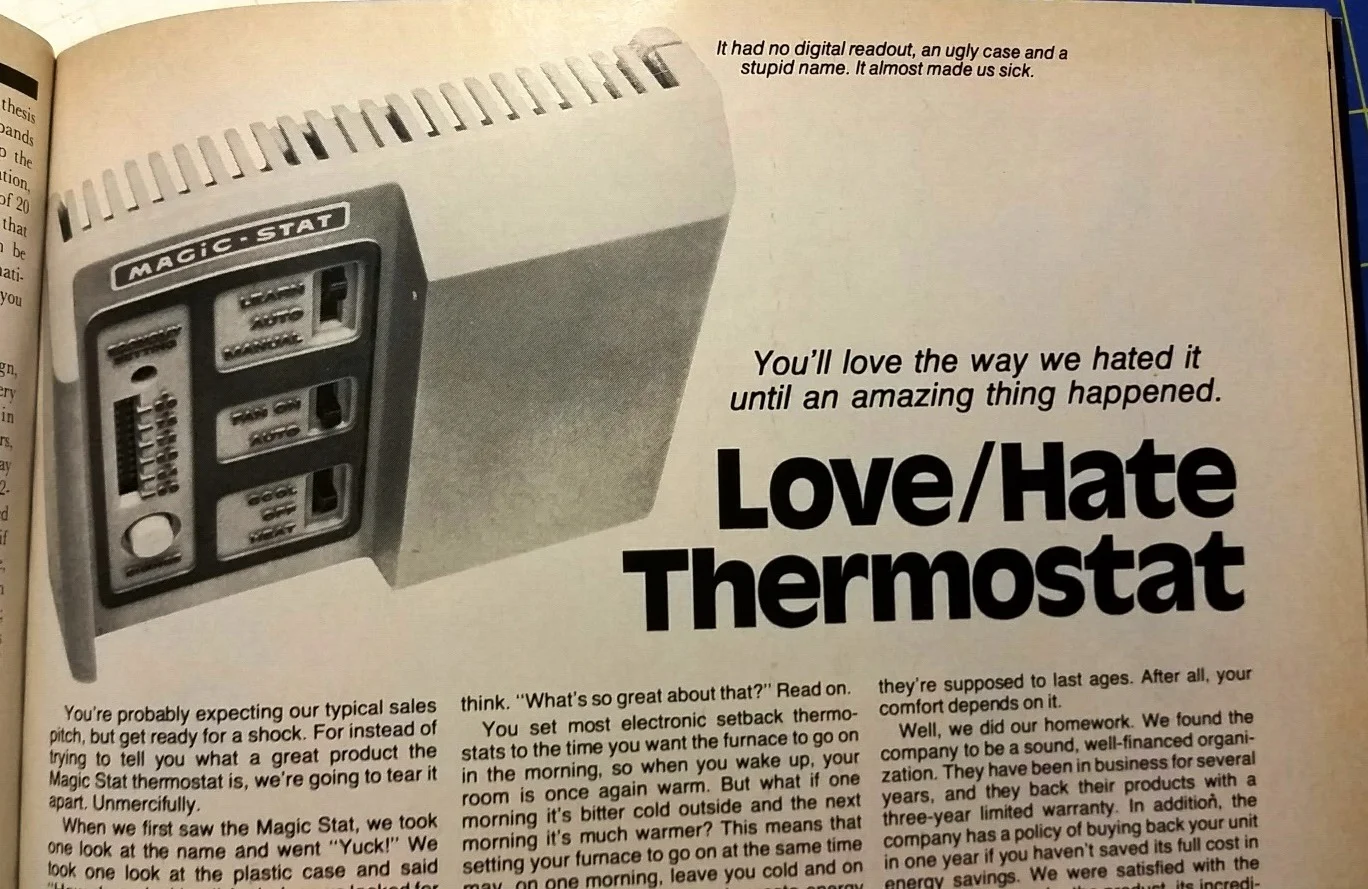
Retro thermostat... 1982 Electronics Guide review of Magic-Stat

Other HVACzoning supply1 Comment
magic-stat.jpg

Published in Playboy's Electronic Entertainment guide in Fall 1982. 

This is off of our normal subject but I came across this old magazine that includes other articles like "There's more to life than Pac-Man: How to beat Donkey Kong" and "What computers can do for you" which says that "VisiCalc is the most popular program of all time with 250,000 copies sold".  And it included a scathing review of this Magic-Stat product.  Sold for $79 mail order.  At first glance, I thought it was just another ugly thermostats in a long history that still goes on today.  Then i read the article which explains a "LEARN" mode that makes it easier to set much like the nest would do decades later.  Also, it claims to have what is now reffered to as "adaptive recovery".  This is where the thermostat starts the equipment before the set time so it can get the home to temperature at a specified time instead of just starting to get to temperature at the time of setpoint.  I haven't done any fact-checking, but it says they are the first thermostat to do this... too bad it took 20 years for this to become a more standard feature.

Here are a few more pics I took of the magazine...i claim no rights or ownership of any of this material.