24VAC damper wiring, damper actuator wiring, Honeywell, DuroZone, EWC, Zonex, ZoneFirst, Belimo and more
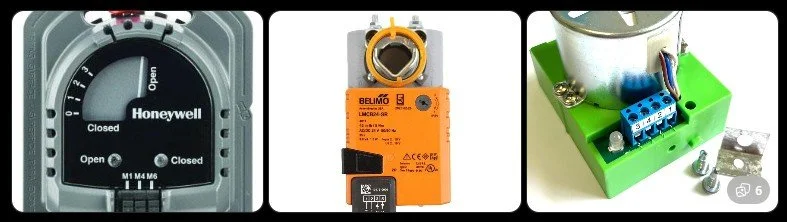
Any 24VAC damper con be connected to SmartZone
One of the most common questions we receive when someone is replacing an old HVAC zoning control panel with an ECOJAY SmartZone is:
“Will my existing dampers work with SmartZone?”
In most cases, yes.
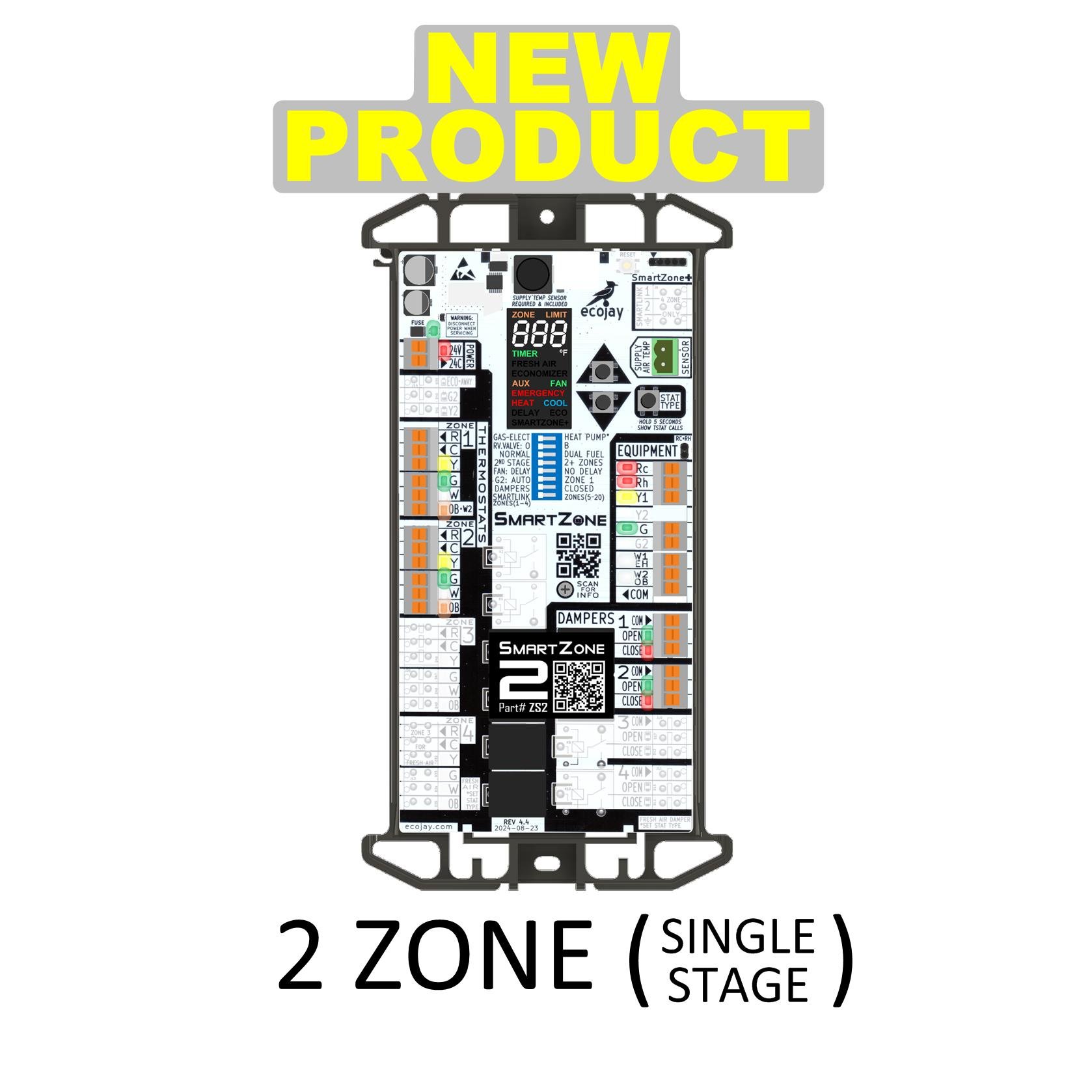
Full-featured SINGLE-stage 2-zone controller on a budget
Simplest version of SmartZone ever
2 ZONE control - (Replaces SmartZone-2L for Single Stage)
Gas, Electric or Heat Pump
1 stage COOL <> 2 stage HEAT
SmartZone is designed to operate conventional 24VAC HVAC zone dampers, and we have successfully worked with a huge variety of damper motors and actuators from many different manufacturers and generations of zoning equipment.
That includes 2-wire, 3-wire, 4-wire, 5-wire, 6-wire and other 24VAC damper configurations.
The examples in this article are some of the more common dampers and actuators you may encounter, but this is NOT a complete list of SmartZone-compatible dampers.
If you have a 24VAC damper that isn't shown here, don't assume that you need to replace it. There is a good chance your existing damper can be connected to SmartZone.
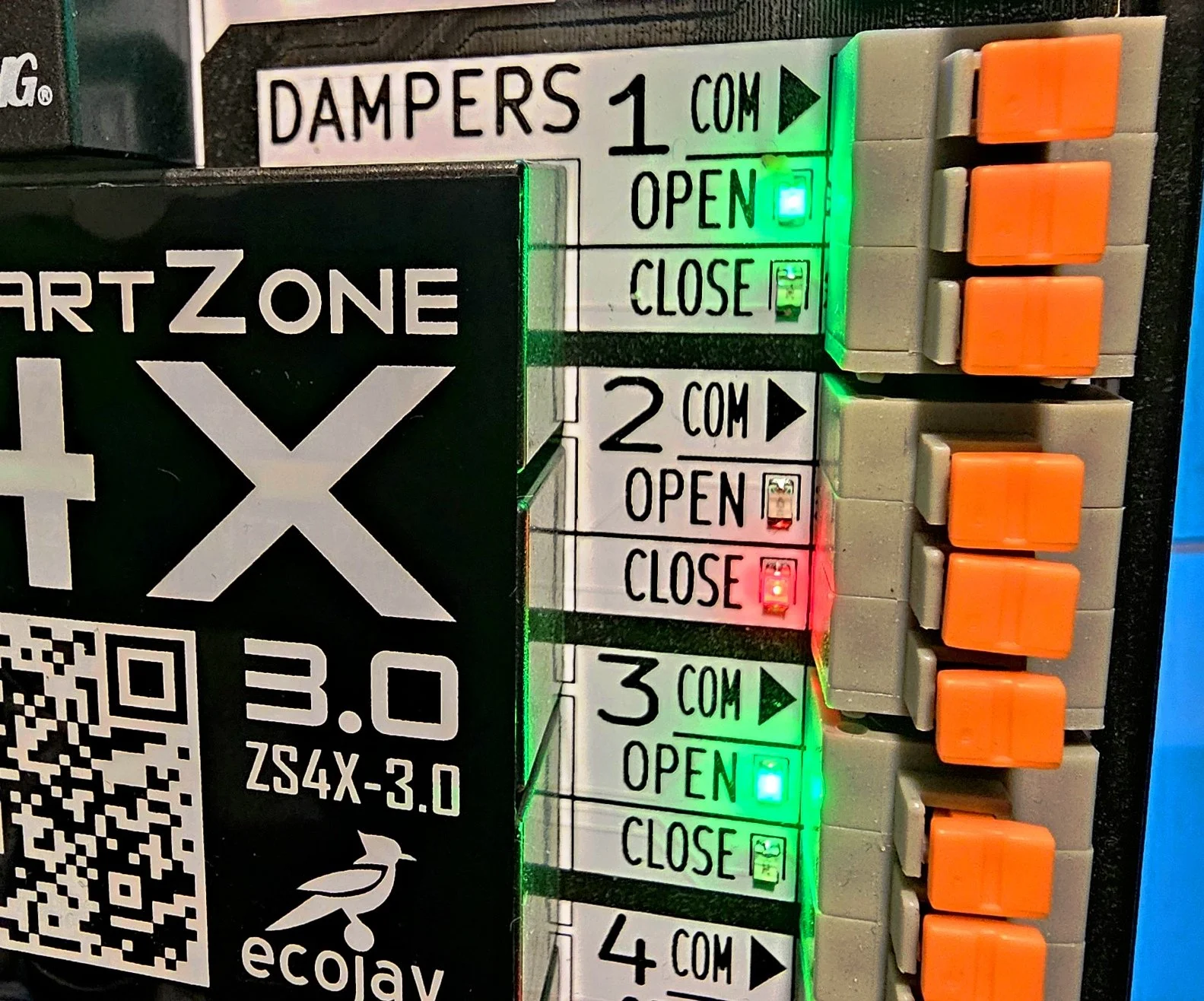
SmartZone Is Not Limited to One Type of Damper
Modern HVAC dampers are often easy to identify because the actuator terminals are clearly labeled:
OPEN — COMMON — CLOSE
But it wasn't always that simple.
Older HVAC zoning systems may have motors with:
Two unlabeled wires
Three wires
Four wires
Five wires
Six or more wires
Numbered terminals
Separate thermostat/control terminals
End-switch terminals
Spring-return motors
Power-open/power-close motors
Older proprietary control arrangements
The number of wires does not by itself determine whether a damper can be used with SmartZone.
What matters is how the 24VAC actuator is designed to operate.
SmartZone provides the conventional 24VAC OPEN / COMMON / CLOSE damper control used by many modern HVAC zoning systems. Older or differently configured actuators may require identifying the correct terminals, and in some cases the actuator may be easier to replace than to adapt.
The important point is:
You don't have to replace your existing dampers just because they came from a different manufacturer or were installed with an older zoning system.
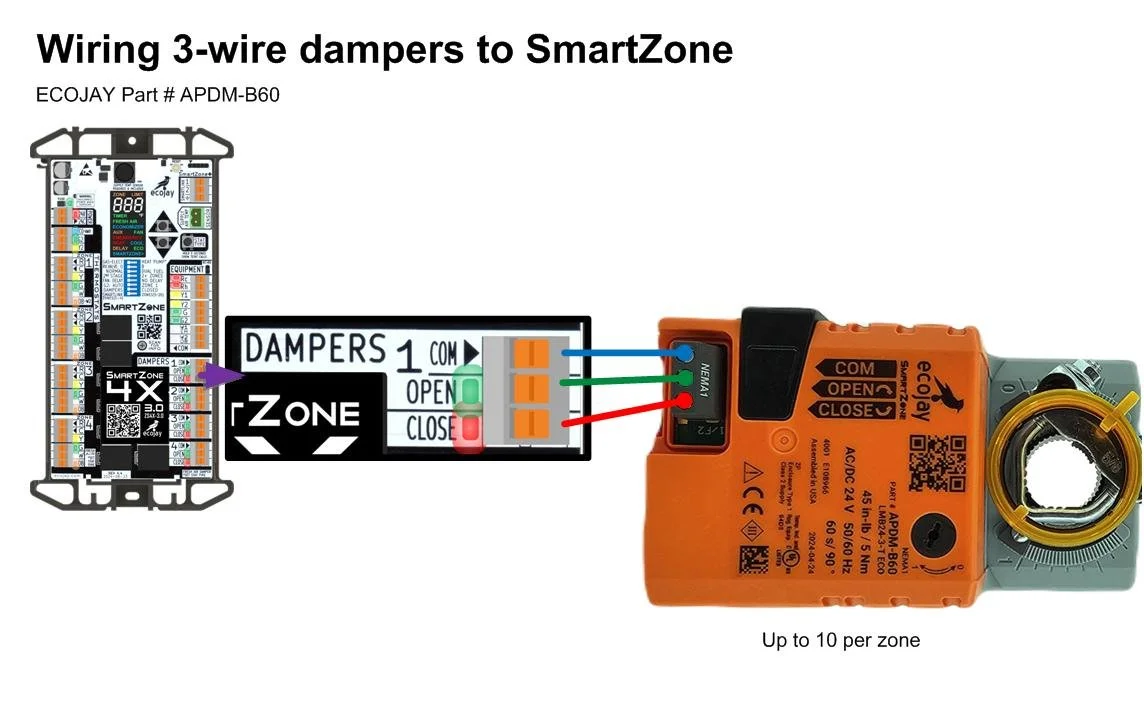
The Most Common SmartZone Damper Connection
For a conventional 3-wire power-open/power-close actuator, connecting the damper is extremely simple.
The SmartZone damper terminals are:
OPEN
COMMON
CLOSE
Connect the actuator accordingly:
SMARTZONE              DAMPER ACTUATOR

OPEN      ──────────── OPEN
COMMON    ──────────── COMMON
CLOSE     ──────────── CLOSE
When SmartZone wants the zone damper to open, it supplies 24VAC to the OPEN circuit.
When SmartZone wants the damper to close, it supplies 24VAC to the CLOSE circuit.
The actuator's internal limit switches stop the motor when it reaches the fully open or fully closed position.
This power-open/power-close design is our preferred type of damper for new installations.
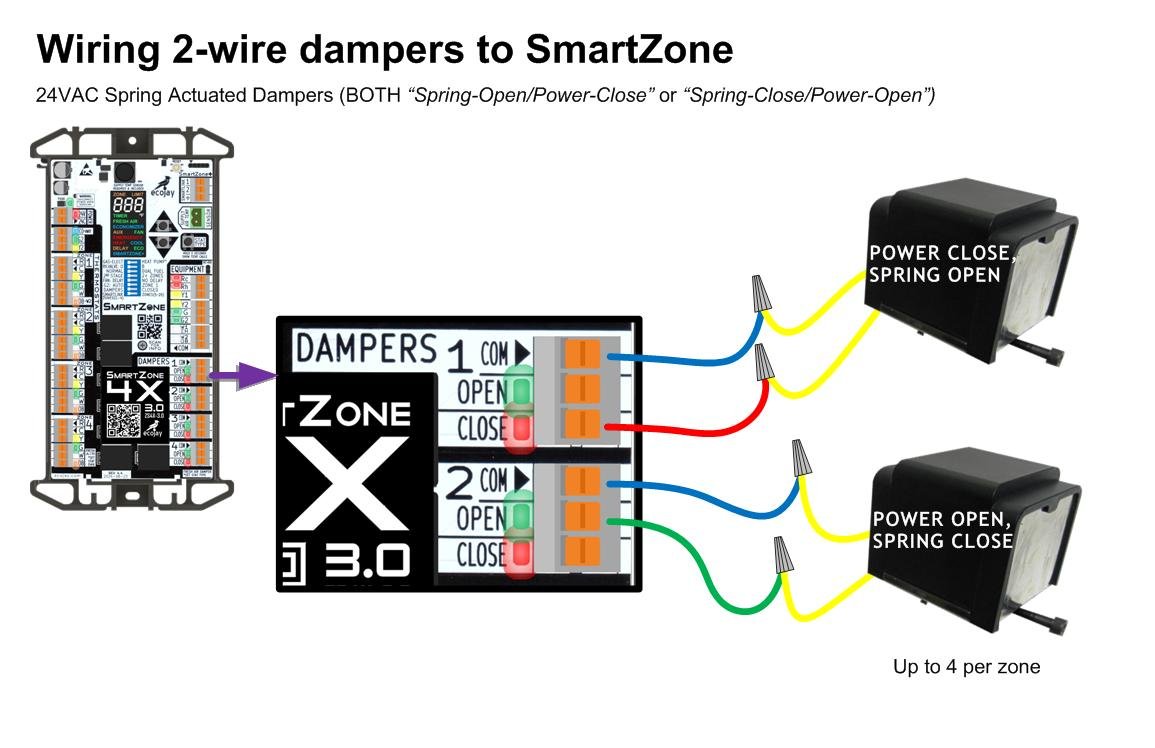
2-Wire Spring-Return Dampers
One of the oldest and most common types of HVAC zoning dampers is the 2-wire spring-return damper.
These actuators typically have only two motor wires.
The actuator receives 24VAC in one direction and uses an internal spring to return the damper to the opposite position when power is removed.
There are two basic possibilities.
Power-Open / Spring-Close
Connect:
SMARTZONE              DAMPER

COMMON    ──────────── Wire 1
OPEN      ──────────── Wire 2
CLOSE     ──────────── Not Used
The damper receives power when SmartZone wants it open. When power is removed, the spring returns the damper toward the closed position.
Power-Close / Spring-Open
Connect:
SMARTZONE              DAMPER

COMMON    ──────────── Wire 1
CLOSE     ──────────── Wire 2
OPEN      ──────────── Not Used
In this configuration, the damper receives power when SmartZone wants it closed. When power is removed, the spring returns the damper toward the open position.
How do you know which one you have?
If the motor doesn't have useful labeling, you can usually determine its operation by identifying the actuator model or carefully testing the motor with 24VAC.
Do not assume that two-wire dampers are interchangeable without determining whether they are power-open or power-close.
Common Honeywell and Resideo Dampers
Honeywell, and later Resideo, have produced thousands of HVAC zoning systems over the years.
You may encounter Honeywell/Resideo damper families including:
ARD
ARD6
ARD8
ARD9
ARD10
MARD
ZD
ZDB
TrueZONE
TrueZONE ARD
ARD6TZ
ARD9TZ
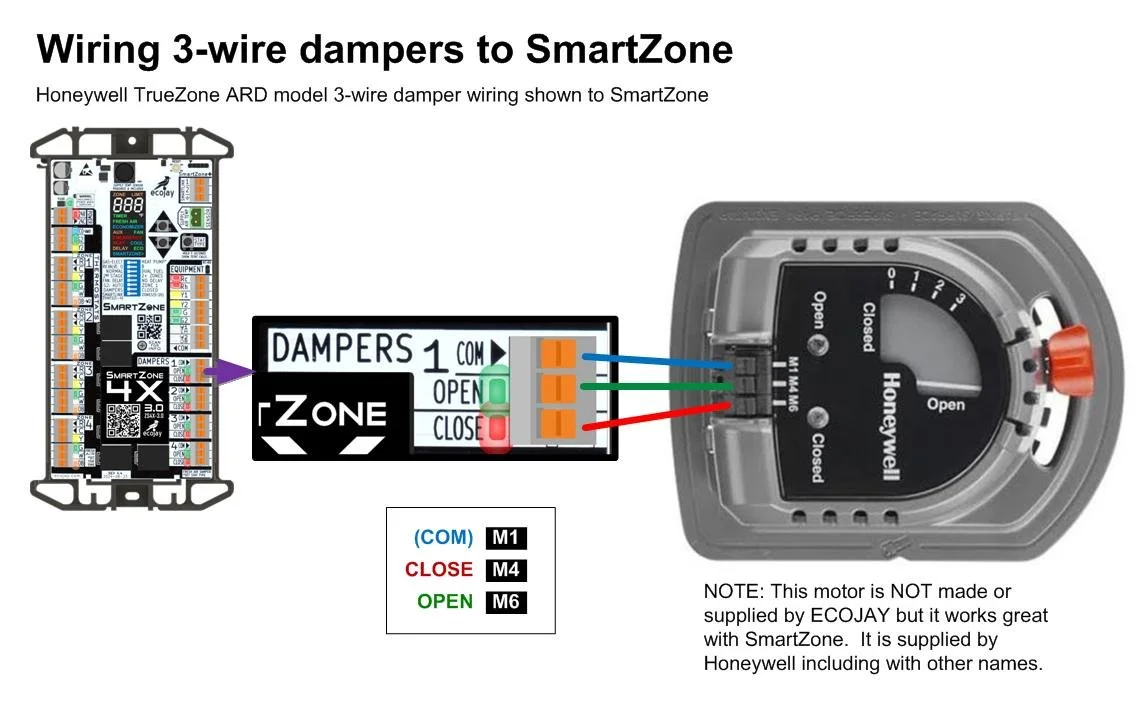
Older Honeywell zoning dampers are particularly common in replacement-zoning projects.
Some use M847D-series spring-return actuators, including part numbers such as:
M847D
M847D1004
M847D1012
Other M847-series actuator configurations
If you have an older Honeywell damper with an M847D-style actuator, don't automatically assume the entire damper needs to be replaced.
The actuator can often be replaced or upgraded while leaving the existing damper installed.
ZoningSupply also offers actuator upgrade solutions for several Honeywell-style dampers.
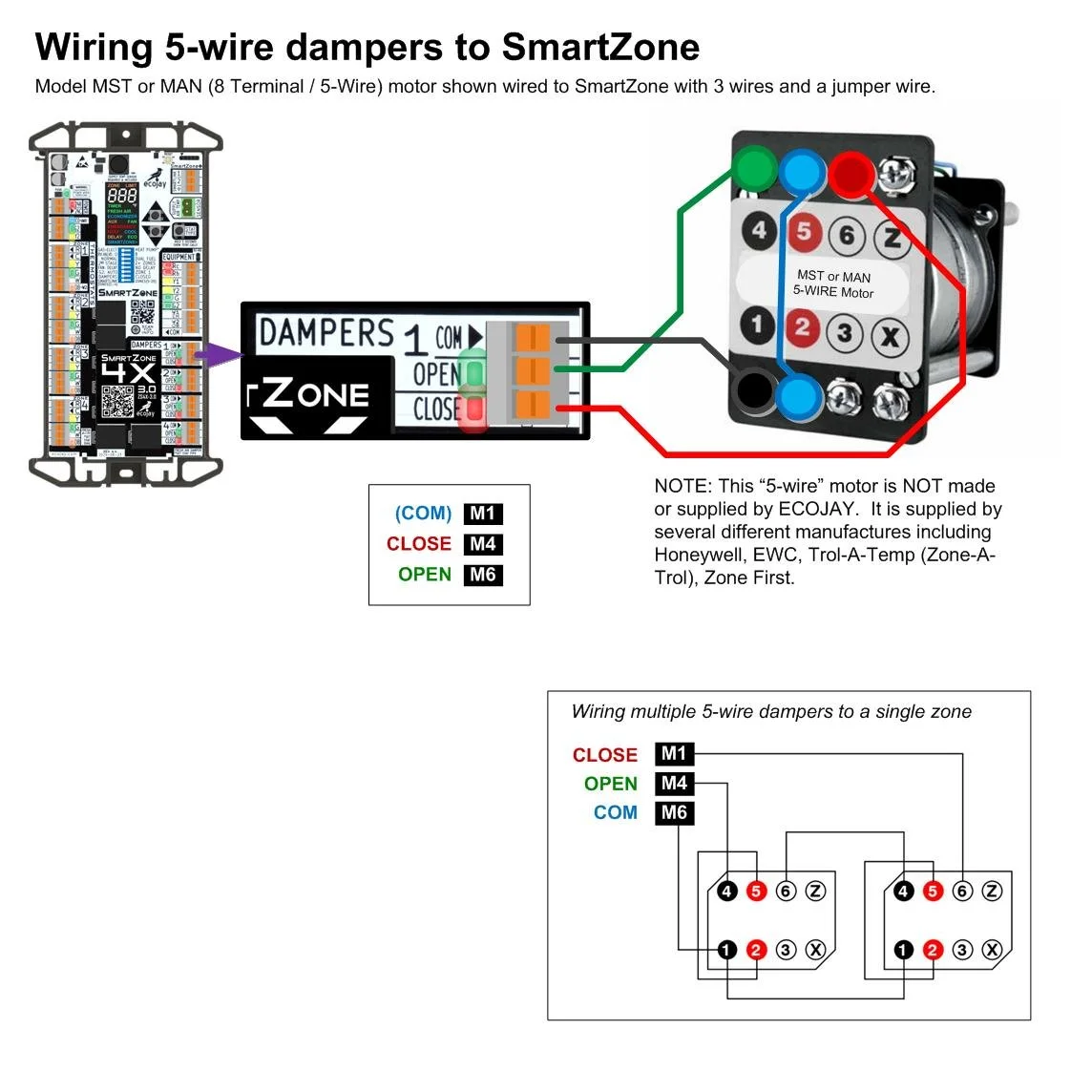
DuroZone / Duro Dyne Dampers
Another very common damper manufacturer is Duro Dyne, whose zoning products are sold under the DuroZone name.
DuroZone has produced many different damper and motor configurations over the years.
You may encounter:
DuroZone RD Series
DuroZone MS Series
DuroZone MB Series
DuroZone MMB Series
DuroZone PMB Series
DuroZone MMB
DuroZone spring-return dampers
Older DuroZone 5-terminal motors
Newer DuroZone 4-terminal motors
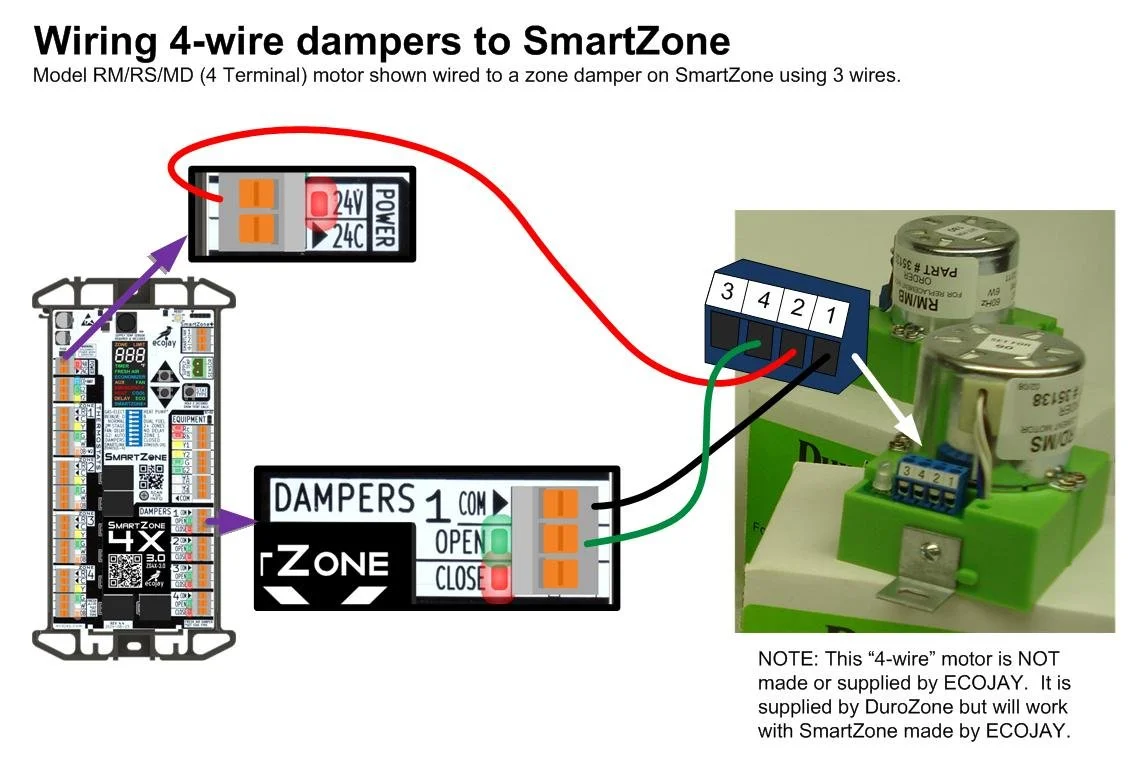
This is an especially good example of why you should not identify a damper solely by the number of wires.
Some older DuroZone motors use a terminal strip numbered:
1 — 2 — 3 — 4 — 5
rather than simply labeling the connections OPEN, COMMON and CLOSE.
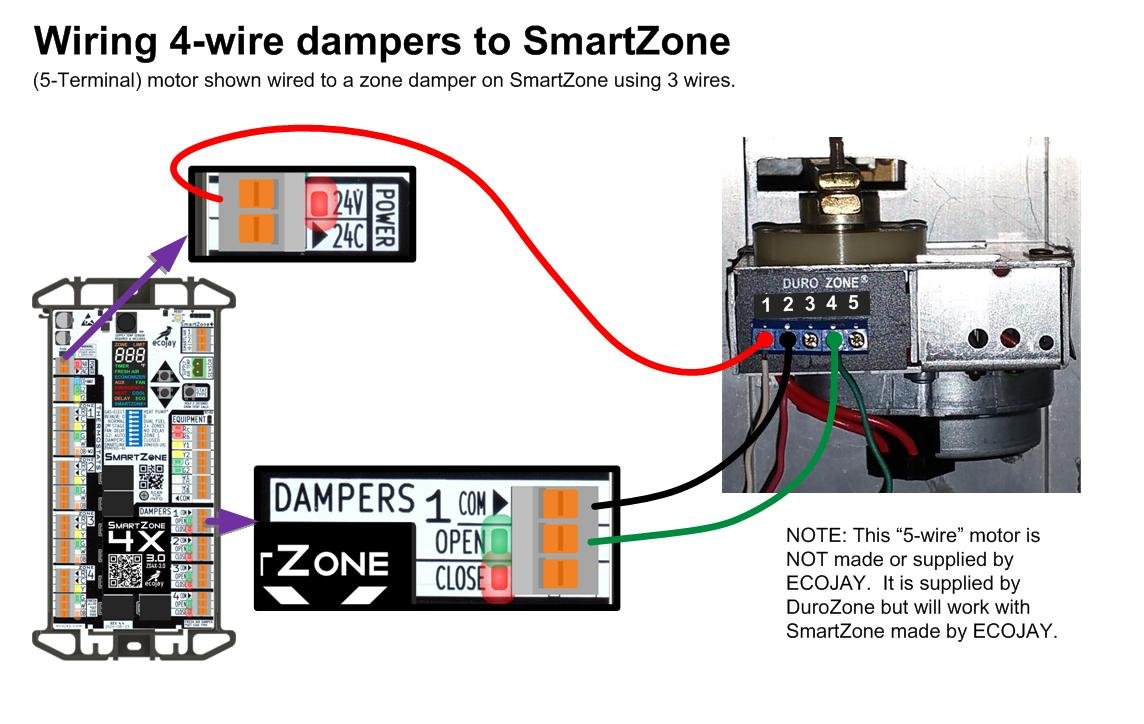
Duro Dyne's own documentation shows older DuroZone motors with five terminals and newer motors with four terminals. Their documentation also provides wiring methods for connecting DuroZone dampers to non-DuroZone zoning panels.
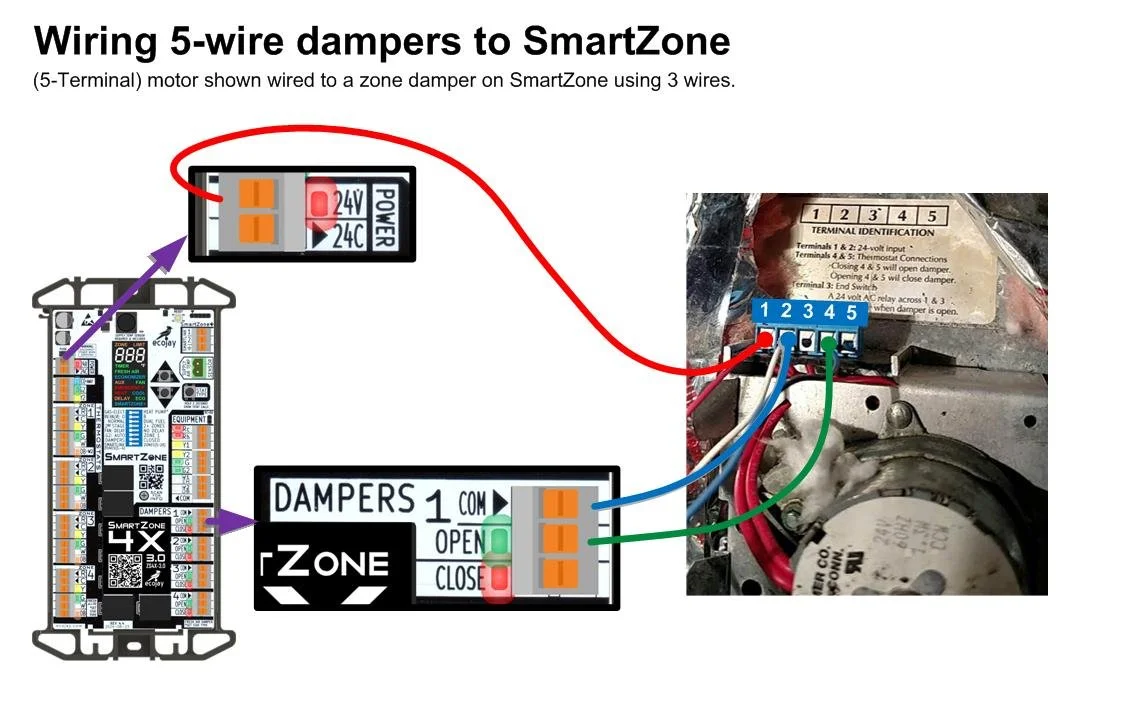
In other words, an old DuroZone damper may look completely different from a modern SmartZone-compatible actuator while still being usable.
DuroZone replacement motor numbers you may encounter include:
RM-RD/MS
RM-MB
RM-PMB
RM-MSSR024
Duro Dyne part numbers associated with these replacement motors
Always verify the exact actuator and terminal configuration before wiring.
EWC Controls Dampers
EWC Controls is another major manufacturer of residential and light-commercial zoning equipment.
Common EWC damper and actuator references include:
MA-ND3
MA-ND4
MA-ND5
MRK
EWC power-open/power-close damper configurations
EWC spring-return damper configurations
EWC's MA-ND-series motors are commonly encountered when replacing or modifying older zoning systems.
Some EWC dampers use the familiar 24VAC power-open/power-close operating method, while other products and older installations may have different configurations.
Always identify the actual actuator installed on the damper rather than relying solely on the damper brand.
Zonex Dampers
Zonex is another manufacturer commonly encountered when replacing older zoning control systems.
You may encounter Zonex components and actuator references such as:
101AHDM
101AMPD
STMPD
STMRTD
STCD
Zonex round dampers
Zonex rectangular dampers
Zonex replacement actuators
Many conventional Zonex dampers use 24VAC motor control, making them good candidates for SmartZone replacement projects.
Again, the exact wiring depends on the actuator installed.
ZoneFirst Dampers
ZoneFirst has also produced a wide range of 24VAC zoning dampers and actuators.
Examples include:
RDM
MDM
ZDS
ZDB
ZDSM
ZDBM
ZoneFirst round dampers
ZoneFirst rectangular dampers
Some ZoneFirst dampers use the familiar 3-wire power-open/power-close arrangement.
If you are replacing a ZoneFirst control panel with SmartZone, check the actuator wiring before replacing the dampers.
Belimo Damper Actuators
Belimo is one of the most widely used HVAC actuator manufacturers in the industry.
You may encounter Belimo actuator families including:
LM
LMB
LMX
TF
GMB
GRB
GMA
LF
AF
Examples of 24VAC actuator part numbers include:
LMX24-3-T
LMB24-3
GMB24-3
GRB24-3
TFB24-3
Many Belimo actuators use floating-point or 3-wire power-open/power-close control.
The LMX24-3-T, for example, is a 24VAC 3-point actuator and is also used as the basis for ECOJAY's power-open/power-close replacement damper motor.
Other Damper Manufacturers You May Encounter
There are many other 24VAC HVAC dampers and actuators in the field.
Depending on the age and type of HVAC system, you may encounter equipment from:
Honeywell
Resideo
Duro Dyne
DuroZone
EWC Controls
Zonex
ZoneFirst
Belimo
AprilAire
Young Regulator
Valemo
Jackson Systems
iO HVAC Controls
Trol-A-Temp
Arzel
Siemens
Johnson Controls
Carrier
Bryant
Trane
American Standard
And many others
There are also countless dampers sold under HVAC contractor, equipment manufacturer and private-label brands.
That's why we don't want this article to be interpreted as a list of the only dampers that work with SmartZone.
It isn't.
SmartZone is designed to work with virtually any conventional 24VAC HVAC damper actuator that uses an appropriate open/close control method.
What About 4-Wire, 5-Wire, 6-Wire and 8-Wire Dampers?
This is where things get interesting.
Some older actuators have additional wires or terminals because the motor includes functions beyond simply opening and closing the damper.
For example, an actuator may have:
24VAC power
Motor control
End-switch contacts
Thermostat/control inputs
Auxiliary contacts
Position indication
Other control circuitry
A five-terminal motor does not necessarily mean that five wires are required between the damper and SmartZone.
One of the best examples is an older DuroZone motor.
Duro Dyne documentation identifies terminals for 24VAC input, thermostat/control connections and an end switch.
The important thing is to identify what each terminal actually does.
Do not simply match terminal numbers.
For example:
Terminal 1 on one manufacturer's motor does not necessarily mean the same thing as Terminal 1 on another manufacturer's motor.
Always use the actuator's wiring diagram or identify the motor's operation before connecting it.
The Damper Motor May Be Old — But the Damper May Be Fine
This is an important distinction.
When an HVAC contractor encounters an old zoning system, it is tempting to assume that the dampers need to be replaced along with the control panel.
That isn't necessarily true.
A damper consists of two basic components:
The mechanical damper assembly
and
the actuator/motor that moves it.
If the damper blade, shaft and mechanical assembly are still in good condition, replacing the actuator may be all that is necessary.
This can save a significant amount of time and money, especially when dampers are installed inside finished walls, ceilings or difficult-to-access ductwork.
Upgrading Old Spring Dampers
Although SmartZone can operate many existing spring-return dampers, we generally recommend power-open/power-close dampers for new installations and upgrades whenever practical.
A spring-return actuator has to use mechanical spring force to return the damper to its opposite position.
A power-open/power-close actuator instead uses:
OPEN
COMMON
CLOSE
to directly control the damper position.
This provides several advantages.
Power-open/power-close advantages
Low power consumption
No return spring required
No spring to fatigue
No spring mechanism to break
Positive control in both directions
Simple 3-wire connection
Excellent compatibility with modern zoning controls
Easy troubleshooting
Easy replacement
ZoningSupply has long recommended power-open/power-close dampers as an upgrade from many older spring-return systems. Our SmartZone specifications likewise call for conventional 24VAC power-open/power-close zone dampers.
What About a Damper That Isn't on This List?
That's perfectly fine.
This article is intentionally not a complete list of compatible dampers.
There have been too many HVAC zoning manufacturers, private-label products, actuator manufacturers and generations of equipment for any list to include everything.
If your damper is:
Honeywell
Resideo
DuroZone
Duro Dyne
EWC
Zonex
ZoneFirst
Belimo
AprilAire
Trol-A-Temp
Arzel
Carrier
Trane
Bryant
Or something we've never heard of
don't assume that it won't work with SmartZone.
If it is a conventional 24VAC damper actuator, there is a very good chance we can determine how to connect it.
How to Identify an Unknown Damper Motor
If you are working on an older zoning system and don't know what you have, start with the actuator.
Take a clear picture showing:
The entire damper actuator
The manufacturer's name
The model or part number
The terminal strip
The terminal numbers or labels
The wires connected to the actuator
If there is a label on the motor, photograph that as well.
For example, a photo showing:
1 – 2 – 3 – 4 – 5
is much more useful than simply telling us:
“It's a five-wire damper.”
The terminal identification tells us what the actuator is actually designed to do.
Can SmartZone Replace My Existing Zoning Panel Without Replacing My Dampers?
In many cases, yes.
This is one of the biggest advantages of SmartZone.
If you're replacing an old zoning panel from Honeywell, DuroZone, EWC, Zonex, ZoneFirst or another manufacturer, you may be able to:
Keep the existing dampers
Keep the existing ductwork
Keep the existing thermostat wiring
and replace the old control panel with a current-generation SmartZone 3.0.
The exact answer depends on the type of actuator being used.
Conventional 24VAC dampers that use a motor with internal limit switches are generally the easiest to integrate.
Some proprietary or unusual systems may use completely different control methods, such as pulsed signals, DC motors, communicating actuators or multi-position controls. Those systems may require actuator replacement.
But don't assume that simply because the existing system is old, the dampers are unusable.
SmartZone Damper Compatibility: The Bottom Line
If you're replacing an old HVAC zoning system, don't replace the dampers until you've checked the actuators.
SmartZone is designed around the conventional 24VAC OPEN / COMMON / CLOSE method used by a huge number of residential and light-commercial HVAC dampers.
But SmartZone isn't limited to one particular damper manufacturer or one particular number of wires.
We've worked with:
2-wire dampers
3-wire dampers
4-wire dampers
5-wire dampers
6-wire dampers
8-wire dampers
and many other configurations.
We've also worked with equipment from manufacturers including:
Honeywell / Resideo
Duro Dyne / DuroZone
EWC Controls
Zonex
ZoneFirst
Belimo
AprilAire
Young Regulator
Valemo
Jackson Systems
Trol-A-Temp
Arzel
and many others.
These are examples — not limits.
Virtually any conventional 24VAC HVAC damper actuator may be able to work with SmartZone.
The actuator's wiring and operating method simply need to be identified first.
Need Help Identifying Your Damper?
If you're replacing an old zoning system and aren't sure whether your existing dampers will work with SmartZone, send us a picture.
A clear photo of the damper motor and its terminal connections is often enough for us to identify the actuator and determine the best wiring approach.
Don't replace an existing damper just because it looks old.
It may be perfectly good.
And if the actuator is obsolete, unreliable or incompatible, we can often recommend a modern 24VAC power-open/power-close replacement actuator that allows you to keep the existing damper assembly.
ECOJAY SmartZone makes upgrading an old zoning system much easier—without automatically requiring you to replace every damper in the building.